Real Estate Articles
REALTOR®: SV Leadership Group Promotes “Clean & Green” Energy Action Plan to local Realtors®
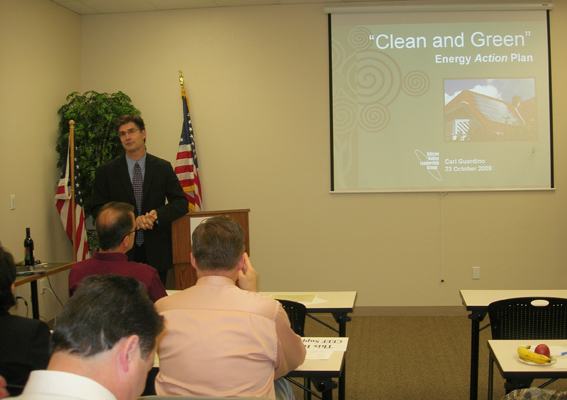
Silicon Valley Leadership Group CEO Carl Guardino spoke to members of the Silicon Valley Association of REALTORS® Los Gatos/Saratoga District and Cupertino/Sunnyvale District. He is pictured here in Cupertino.
It's high time everyone take note of the importance of saving energy and using alternative energy sources, according to Silicon Valley Leadership Group CEO Carl Guardino. This is why he hailed the passage of AB 32 - The Global Warming Solutions Act of 2006, and hopes Measure B, which deals with BART's extension to Santa Clara County, and California Proposition 1A, a $9.95 billion dollar bond, both pass on the November 4th ballot.
Guardino introduced the Leadership Group's "Clean and Green" Energy Action Plan to members of the Silicon Valley Association of REALTORS®,a plan which focuses on policies and programs to curb greenhouse gases. The plan includes working with Silicon Valley municipalities to develop building policies and programs that encourage the private and public sector to build green. Studies show buildings in the U.S. account for 36 percent of total energy use, 30 percent of greenhouse gas emissions, 30 percent raw materials use and 30 percent waste output.
Another project underway is the Energy Watch Partnership with SVLG, Sustainable Silicon Valley and PG&E, which could generate a savings of $3.5 million a year. The partnership aims to provide comprehensive services and attractive rebates to employers seeking to boost their efficiency and save on operating costs. The savings should position companies to remain competitive should energy costs continue to increase, said the SVLG CEO.
Guardino said Silicon Valley is very much at the heart of the solar revolution.
"I want Silicon Valley to be Solar Valley," Guardino announced.
To achieve this goal, the SVLG has launched the SolarTech Initiative, which is actively working to resolve inefficiencies in permitting, installation, interconnection processes, performance standards, shortages in trained workforce, and financing to promote the solar industry.
Data center efficiency is also an issue that needs to be addressed, Guardino said. Data centers use nearly 1.5 percent of all the electricity generated in the U.S., costing 4.5 billion annually. He warned by 2011 U.S. data centers would consume up to 100 billion kWh at a cost of $7.4 billion a year, and there would be a need for 10 more power plants.
Then there's the transportation sector. Fifty percent of greenhous gases in Silicon Valley and the Bay Area come from the transportation sector. Guardino said improvements here fall into two categories - making cars more environmentally friendly, and making cars less necessary by offering alternative means of transportation.
"Energy saving starts with the individual, beginning with encouraging people to buy energy saving vehicles, converting four wheels to two wheels or even no wheels," Guardino said.
He said activities like the CEO/Celebrity Cycle-to-Work Day, an annual national event held in May, encourages residents to bike to work because seeing CEOs do it "projects the acceptance factor that it's all right to do." Studies show four out of 10 commutes to work are five miles or less in the Bay Area
Guardino then turned his attention to Measure B, the proposal for a 16.1 mile extension of BART into Santa Clara County, with stations in Milpitas, San Jose and Santa Clara, connecting with Caltrain, projected to bring at least 100,000 weekday passengers. The 104-mile BART currently carries 370,000 weekday passengers.
If voters approve the one-eighth cent sales tax in November, Guardino said it will not only increase the convenience of commuting for thousands of people, but it will also help the environment. BART's extension would carry the equivalent of two lanes of freeway traffic, he said. The gasoline saved by cars not driven would be the equivalent of two tanker trucks – 12,000 gallons a day. Also, Guardino said with the BART extension, projections are by 2030, 91 percent of Santa Clara County residents would live within three miles of a rail station – either BART, Caltrain or light rail – all connected to one another.
The November election will also put to a vote the proposal to construct a high speed rail line capable of traveling 200 plus miles-per-hour, which would transport riders from Los Angeles to San Jose in two hours, or two and a half hours to San Francisco. It is projected high speed rail would transport 117 million passengers annually by 2030, which could save 12.7 million barrels of oil per year by 2030, and prevent 12 billion pounds of green houses gas emission by 2030.
"I've had calls from CEOs who are losing employees because they cannot afford to d rive to work because of the high price of gas. It's an important issue we need to address," Guardino said.
The Silicon Valley Association of REALTORS® (SILVAR) is a professional trade organization representing over 4,000 REALTORS® and Affiliate members engaged in the real estate business on the Peninsula and in the South Bay. SILVAR promotes the highest ethical standards of real estate practice, serves as an advocate for homeownership and homeowners, and represents the interests of property owners in Silicon Valley.
The term "REALTOR®" is a registered collective membership mark which identifies a real estate professional who is a member of the National Association of REALTORS® and who subscribes to its strict Code of Ethics.
Variations of this article have appeared in local area newspapers.
For further information, please email or call the SILVAR office at (408) 200-0100.