Real Estate Articles
Berkeley professor says high expectations driving Bay Area property values up
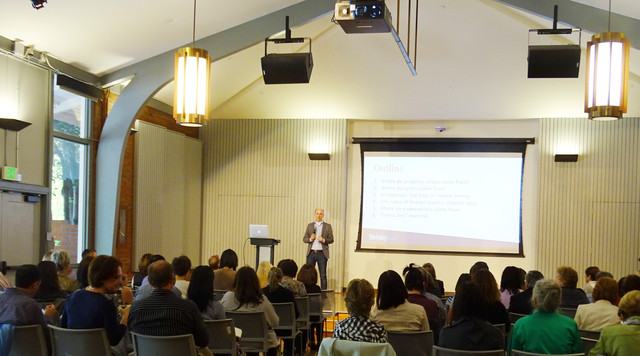
Real estate cycles come from changes in demand and supply fundamentals and expectations, which can change with fairly high frequency. Right now, high expectations of fundamentals are what are driving property values up in the Bay Area, according to Christopher Palmer. The assistant professor of Real Estate & Urban Economics at the Haas School of Business, UC Berkeley, recently spoke to nearly a hundred members of the Silicon Valley Association of Realtors about the current real estate and business cycles.
Examples of demand fundamentals are increased income, jobs, amenities and availability of credit. Example of supply fundamentals are availability of land and development costs. Currently, most of the region's fundamentals are strong and expectations are high that they will continue to be that way for a while.
Palmer indicated there is diversification in the region because many companies in the Bay Area are revenue producing. Foreign buyers still see the U.S. and the Bay Area, in particular, as a safe haven for their money. Data shows foreign buyers are investing more in commercial property these days than residential.
Like the stock market, buying real estate can't always be timed. Palmer said buyers also should be cautious about relying on their network's perception of real estate. Perceptions of real estate's riskiness can depend in part on who your friends are. Studies show in a hot market, over 5 percent of friends are likely to buy real estate or start looking.
"Know where your clients get their information," Palmer advised Realtors.
The UC Berkeley professor believes worries about rising interest rates are overblown; nevertheless, it is always good to have a reality check and know that when the cycle drops "you can sleep through the storm."
"We'll have increasing volatility, but if we stress-test ourselves we should be fine," said Palmer.
With escalating home prices and rents, Palmer said the drive towards rent control in the Bay Area is understandable, but not the best option. He said rent control is a "blunt instrument" that does not help those who really need it
"It only works for incumbent residents and does nothing for the future," said Palmer.
A study Palmer conducted on the effects of rent control in the city of Cambridge, Mass. found that the city's rent control ordinance reduced the quantity and quality of available housing. There was a mismatch between those who could get rent-controlled apartments and those who needed it most. Rent control pushed rents even higher in non-controlled units and produced a low turnover. Since landlords could not raise rents, it killed incentives to make improvements to rental units.
Palmer suggested better alternatives to rent control would be expanding the Section 8 voucher program by making it portable; providing help with tax credits; relaxing regulations regarding accessory dwelling units; densification; modular housing; fast-tracking authority, such as developers bypassing local governments and going straight to the state for approval.
The Silicon Valley Association of REALTORS® (SILVAR) is a professional trade organization representing over 4,000 REALTORS® and Affiliate members engaged in the real estate business on the Peninsula and in the South Bay. SILVAR promotes the highest ethical standards of real estate practice, serves as an advocate for homeownership and homeowners, and represents the interests of property owners in Silicon Valley.
The term "REALTOR®" is a registered collective membership mark which identifies a real estate professional who is a member of the National Association of REALTORS® and who subscribes to its strict Code of Ethics.
Variations of this article have appeared in local area newspapers.
For further information, please email or call the SILVAR office at (408) 200-0100.