Real Estate Articles
REALTORS®: Be Alert to Changes in Lending Market and Communicate, Panel Advises
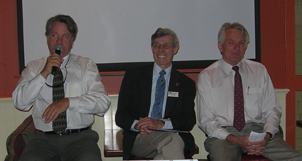
Pictured left to right are David Eshelman (Finet of Saratoga), Silicon Valley Association of REALTORS® Board Director John Tripp (Foundation Trust) and Terry Leary (Empire Equity Group, Inc.).
We are in a changing market and it's a time of challenge for everyone involved in the real estate industry, Finet of Saratoga mortgage specialist Dave Eshelman told members of the Silicon Valley Association of Realtors at a recent Los Gatos/Saratoga District tour meeting.
Eshelman, Silicon Valley Association of Realtors board director John Tripp (Foundation Trust) and Terry Leary (Empire Equity Group, Inc.), all members of the district's finance committee, comprised a panel informing Realtors about how to avoid mishaps with home loan qualifications, and what to expect with the current standing of the lending business. Sharon Butler (Loan Source) served as moderator.
There have been so many changes in the last six months, particularly with regard to lender guidelines, programs and even choices of lenders. It is a contracted market, with stricter guidelines and disappearing programs, said Eshelman. Loans that have been pre-approved all of a sudden are no longer approvable; programs once offered have suddenly been discontinued.
Eshelman stressed agents need to keep on top of programs and guidelines, and keep in touch regularly with lenders.
"You need to work with someone you trust that has experience and stick with that person," Esheman added.
Tripp is a member of the local Realtor association's Professional Standards Committee and a mediator for the association. He reported the number of arbitration cases and grievances has more than doubled this year in comparison to last year. In the month of July, he served as mediator in four arbitration cases. He has four cases scheduled for August.
Tripp gave examples of cases in which the selling and listing agents both lost. In both cases, there was a complete lack of communication between the agent and the financing person, Tripp said. His message: Realtors need to make a greater effort communicating with the lender.
"The climate has changed," Tripp said. "You need to go beyond what you normally would in the past. The playing field is a lot narrower today."
These days it is no longer enough to call the lender and wait for the lender to get back to you. Tripp said phone calls need to be followed-up and, if they are not returned, the agent needs to see the lender in person and, always document everything.
Just to be safe, Tripp urged, "I'm telling you right now, if you are a listing salesperson, you had better request permission to talk directly to whoever's handling the loan for the buyer."
How can Realtors protect themselves and their clients? Leary suggested first, Realtors should lock loan rates promptly. "When you lock a rate on a loan, you lock the guidelines. It's like an insurance policy, in case the program is cancelled," he explained.
Second, in the face of uncertainty in the lending industry, Leary advised Realtors to develop more lender contacts. "Lenders may face dwindling scenarios," he said. "So you need to meet more people and get more choices."
Though the panel agreed these are hard times for those looking for loans, they said things could be a lot worse.
"We have one of our greatest resources right here in each other," Leary exclaimed.
The Silicon Valley Association of REALTORS® (SILVAR) is a professional trade organization representing over 4,000 REALTORS® and Affiliate members engaged in the real estate business on the Peninsula and in the South Bay. SILVAR promotes the highest ethical standards of real estate practice, serves as an advocate for homeownership and homeowners, and represents the interests of property owners in Silicon Valley.
The term "REALTOR®" is a registered collective membership mark which identifies a real estate professional who is a member of the National Association of REALTORS® and who subscribes to its strict Code of Ethics.
Variations of this article have appeared in local area newspapers.
For further information, please email or call the SILVAR office at (408) 200-0100.