Event Coverage
Housing Market Trends and Forecast 2026
 Lawrence Yun
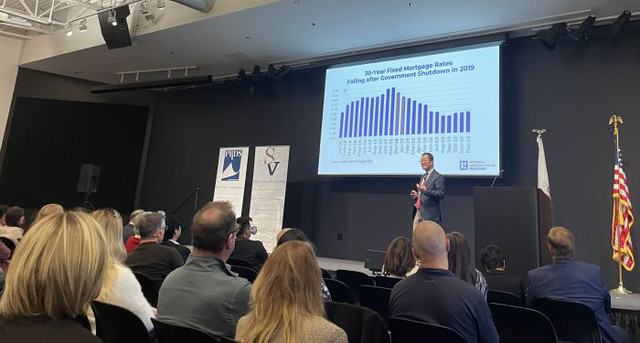
On Monday, Dec. 1, 2025, members gathered at the Computer History Museum to hear Lawrence Yun, Chief Economist of the National Association of REALTORS® (NAR), deliver his forecast, "Housing Market Trends and Forecast 2026." Yun painted a picture of a national market poised for recovery, driven by falling interest rates, while highlighting the exceptional nature of the local economy.
Yun began by acknowledging the Bay Area's extraordinary economic power. "The Bay Area is...like the Renaissance Center...it's the tech edge, the technology frontier area," he stated. Yun further explained that this innovative environment, however, has created unique housing challenges. For example, young people and first-time buyers face a "major hurdle to become a homeowner in this area" if they are not in the tech sector or cannot get help with a down payment from their parents.
Yun noted a clear division in the local economy: homeowners are financially comfortable, benefiting from record-high housing wealth, while non-homeowners have "fully stretched" budgets, prompting many to consider leaving for more affordable states
Despite the job market holding on and the country not being in a recession, a deep sense of gloom pervades the consumer outlook. Citing the University of Michigan Index, which showed that consumer sentiment is "historically low," Yun pointed out that consumers are "expressing huge displeasure—unhappy about the direction of the economy's condition."
This stress is showing up in non-mortgage debt. He said that, "The only minimum that people are paying on time is mortgages," but delinquency rates are rising for auto loans, credit cards, and student debt. However, Yun offered a counter-argument to fears of a housing crash: because today's mortgages are high quality and homeowners are current on their payments, there is no major influx of distressed property, which means home prices are in "no danger of major decline."
A key driver for the 2026 forecast is the Federal Reserve's policy shift. The Fed, which has a dual mandate to control inflation and avoid a recession, is now focused on the softening job market. Even though inflation is "not fully contained," the Fed is compelled to cut interest rates because they "see some weakness in the job market."
While the all-time low of 3-4% mortgage rates is unlikely to return, the 30-year fixed-rate mortgage average is expected to trend down to 6%, an improvement over the 7-8% peak. "The 6% mortgage rate will be better than what has happened in the past three years," Yun noted. "This reduction in interest rates will have a tangible effect on the market."
Yun described how the market has been "very tough for the past three years" due to the sales volume being significantly down after the pandemic. Looking forward, he predicted that a 6% mortgage rate, combined with further Federal Reserve cuts, will unlock significant buyer interest.
NAR's analysis shows that if the rate hits 6%, the housing market will "essentially have about 14% growth in home sales" next year. Meanwhile, Bay Area home prices are expected to continue rising, with a forecasted growth rate in the range of 2% to 6%. Yun concluded that while economic challenges remain, the combination of falling rates and high-quality mortgages sets the stage for a much-needed sales rebound.
The Silicon Valley Association of REALTORS® (SILVAR) is a professional trade organization representing over 4,000 REALTORS® and Affiliate members engaged in the real estate business on the Peninsula and in the South Bay. SILVAR promotes the highest ethical standards of real estate practice, serves as an advocate for homeownership and homeowners, and represents the interests of property owners in Silicon Valley.
The term "REALTOR®" is a registered collective membership mark which identifies a real estate professional who is a member of the National Association of REALTORS® and who subscribes to its strict Code of Ethics.
For further information, please email or call the SILVAR office at (408) 200-0100.